


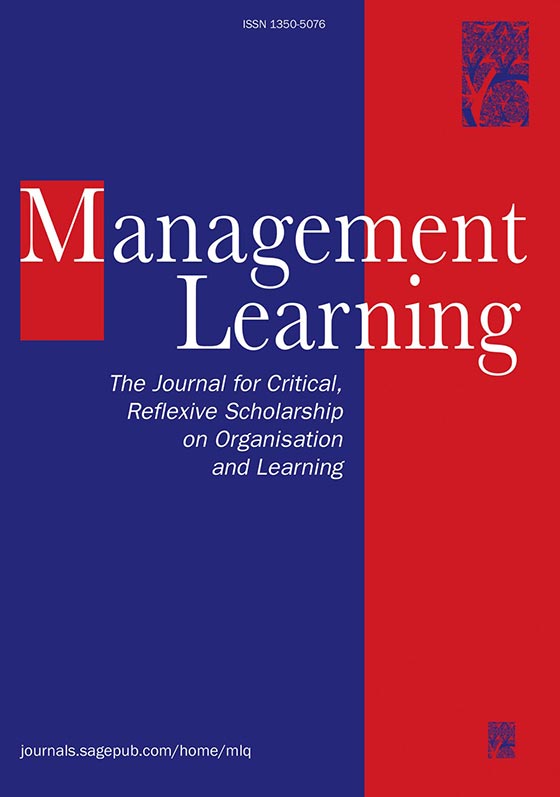
Management Learning

Impact Factor: 3

Coeditors-in-Chief: Martyna Sliwa, Ajnesh Prasad

Sub-Specialty: Business, Management

Discipline: Business, Management

Description:

Management Learning is:Inclusive: covering all aspects of learning and knowing in management and organizations, encouraging interdisciplinary dialogue, and promoting a range of methodological and theoretical approaches;Innovative: publishing high-quality work derived from critical, imaginative and committed inquiry which builds new ideas and developments relating to theory, pedagogy and practice;International: addressing international and multi-cultural aspects of learning, with an international base of readers, authors, reviewers and editorial board members;Integrative: linking research, theory, methods and practice;Impactful: aspiring to publish papers that are influential both within the field of management and organizational scholarship, and in the arenas of policy and organizational practice.Articles in Management Learning advance theory and practice through two defining characteristics: they engage in critique, and are thought-provoking. These characteristics suggest a processual, provisional and potentially contested view of knowledge and learning, and emphasize the need to open-up existing ways of thinking to scrutiny. In doing so, they promote new perspectives and interpretations. Authors should therefore move beyond descriptive and conventional views to reflect upon, analyse and critique; be explicit about their philosophical and/or theoretical perspective; and explain and justify their methods and data analysis. Conclusions should be clear, well-developed, and fully justified.Manuscripts should be situated within a relevant body of literature, connect to important conversations in the field and the journal, make a significant and substantial contribution to the development of management and organizational learning, and be coherent, clear and compelling. We encourage submissions from a variety of theoretical perspectives including critical, poststructuralist, feminist, interpretive, phenomenological, discursive, semiotic and aesthetic perspectives. Authors should carefully and persuasively craft their argument by clearly stating their contribution and ensuring that their philosophical and/or theoretical perspective, the method, analysis, discussion and conclusion are consistent and coherent. Papers should convey commitment and excitement, and use accessible and direct language. While many of our readers are scholars and researchers, Management Learning addresses a wider audience with an interest in management learning. Esoteric language should therefore not stand in the way of effective communication and discussion.”No other journal so successfully communicates the richness of the field of knowledge, knowing and learning in management education and in organizations as well,” Silvia Gherardi”This remains one of the very few ‘must read’ journals that I get,” Karl Weick”As the most innovative and exciting journal in its field, I recommend Management Learning to anyone interested in advancing more critical and challenging approaches to the diverse forms of management education,” Hugh WillmottThis journal is a member of the Committee on Publication Ethics (COPE).Submit your manuscript today at https://mc.manuscriptcentral.com/management_learning.

Link To Journal

Sage Media Kit

Contact Our Sales Team