


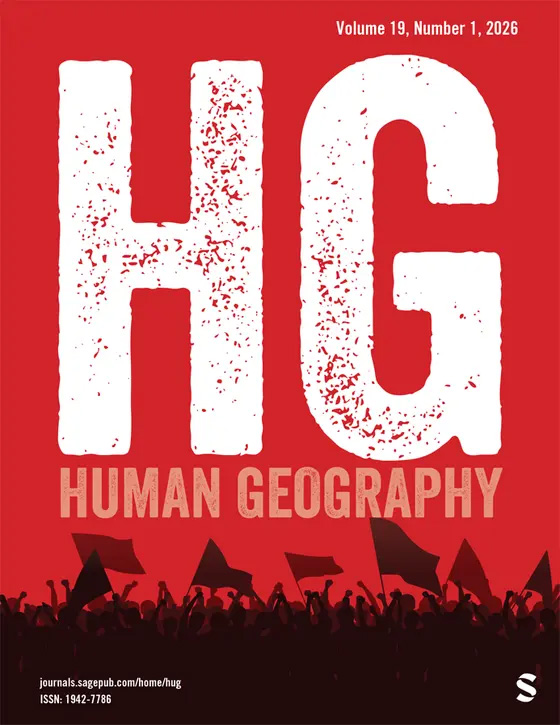
Human Geography

Impact Factor: 7.1

Coeditors-in-Chief: Richard Peet, Waquar Ahmend, Ipsita Chatterjee

Society Affiliation: Institute for Human Geography

Sub-Specialty: Geography and Urban Studies, Planning

Description:

Human Geography is a peer-reviewed scientific journal published three times per year by SAGE publishing and independently owned by the non-profit Institute of Human Geography. HG is broadly conceived to cover topics ranging from economic, urban, social, cultural and geopolitical issues. Therefore, HG is committed to an array of research ranging from political economy, to cultural economy to political ecology. It is envisaged as a well-written, critical, political, and intellectually rich journal that can be read in its entirety, stimulate debates and spark social change. HG is a forum for all kinds of therotical praxis like Marxism, anarchism, post-Marxism, post-structuralism, post-coloniality, feminism, queer theory that challenges exploitation and oppression in any form. HG hopes to radicalize the academia by producing knowledge that is life-transforming because it aligns with the exploited in intellectually critiqing class supremacy, imperialism, racism, sexism, war, genocide, and destruction of the environment. In producing knowledge that is radically critical of the status quo, it hopes to challenge class-power, state-power, corporate power, racism, patriarchy, homophobia and therefore, challenge capitalist social reality.HG was founded by Richard Peet with his graduate students at Clark University. The first issue of the journal was published in early 2008. Richard Peet served as the editor of the journal from 2008 through 2018. The vision was to provide an intellectual space for graduate students, and radical academics to fearlessly publish their point of view about the world written in an engaging and interesting manner without having to pander to citation politics, bow to academic censorship, and having to mute their ideological fervor. The founders of the journal were of the opinion that graduate students and early career academics of leftist/Marxist disposition were finding it increasingly difficult to get favorable reviews from anonymous reviewers that often in the name of ‘publishability,’ squeezed the revolutionary passion right out of the articles. Keeping this in mind, HG was started as a challenge to academic status quo in addition to all other forms of elitism. In this way, HG attempts a dialectical praxis—changing the world by challenging the nature of academic knowledge production, afterall, the material and ideological are inseparable.The very first issue of Human Geography, published in 2008, set the precedent for inclusivity and diversity in representation of radical scholarship in the journal. In this first issue, while Derek Gregory focused on the Foucauldian concept of biopolitics in examining conflict in Baghdad, Utsa Patnaik used quantitative techniques in her paper to analyze the reasons for declining incomes and nutritional standards of agriculture-dependent populations in India. While Richard Peet engaged with concepts proposed by Marx, Hilferding and Harvey in examining global finance capital, the book reviews focused on post-structural feminism, race theory and radical activism. And over the years, HG has become a venue where scholars like David Harvey, Diana Liverman, Neil Smith, Michael Watts, James K. Gailbraith, Utsa Patnaik, Noura Erakat, Kevin Cox, Noel Castree, Nancy Ettlinger, Patrick Bond, Baburam Bhattarai, and several others have chosen to publish their research, reviews and ideas.Submit your manuscript today at https://mc.manuscriptcentral.com/hug

Link To Journal

Sage Media Kit

Contact Our Sales Team