


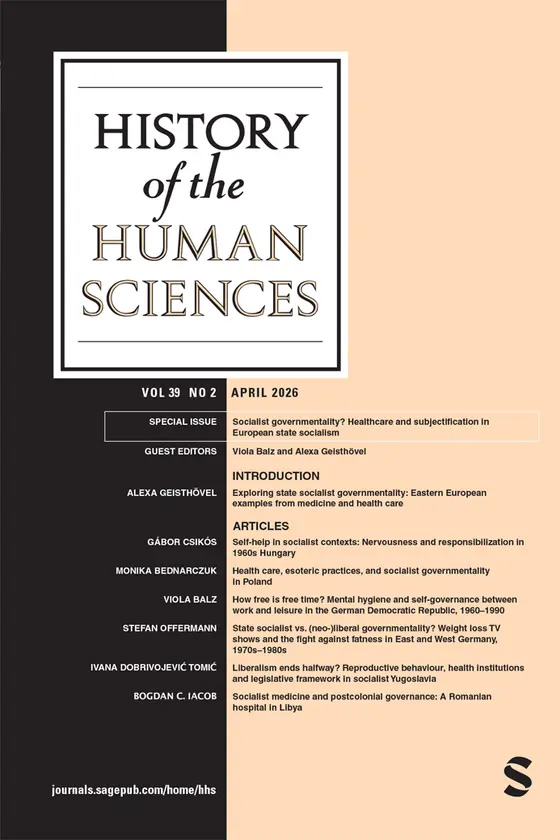
History of the Human Sciences

Impact Factor: 0.5

Coeditors-in-Chief: Felicity Callard, Rhodri Hayward, Sarah Marks, Chris Millard, Amanda Rees, Chris Renwick

Sub-Specialty: Sociology, Gender Studies, Cultural Studies

Discipline: Science, Society Studies

Description:

History of Human Sciences is an international journal of peer-reviewed scholarly research, which provides an important forum for contemporary research in the social sciences, in the humanities, and in human psychology and biology. It is especially concerned with research that reflexively examines its own historical origins and interdisciplinary influences in an effort to review current practice and to develop new research directions.Critical Examination In recent years we have witnessed a significant convergence of interest between the social sciences and the humanities – as well as in relation to the psychological and biological sciences. Scholars are critically examining their traditional assumptions and preoccupations about human beings, their societies and their histories in light of developments that cut across disciplinary boundaries. An Interdisciplinary Approach History of the Human Sciences aims to expand our understanding of the human through a broad interdisciplinary approach. The journal publishes articles from a wide range of fields – including sociology, psychology, anthropology, political science, philosophy, literary criticism, critical theory, art history, linguistics, and the law – that engage with the histories of these disciplines and the interactions between them. The journal does not restrict its remit to any particular theoretical, historiographical or methodological orientation, but rather seeks to expand the analytical frameworks used to understand the histories and epistemologies of the human sciences. That said, a successful article will typically:     • address at least one of the modern human sciences broadly conceived (including psychology, psychiatry, psychoanalysis, history/historiography, medicine, sociology, anthropology, economics, geography, political economy, human biology, neuroscience, critical theory, linguistics, literary theory). By ‘modern’, we generally mean post-Cartesian, though we are not averse to submissions on ancient human sciences (e.g., Ancient Greek psychology, medieval medicine) if the approach has significance for modernity or is interpreted from a modern point of view (as in, for example, Foucault).     • take an intellectual-historical or an interdisciplinary approach (or in the best-case scenario, both of these) to open up epistemological and/or historiographical questions relating to the chosen topic or problematic.     • address questions of method. In general, we avoid publishing:     • Strictly disciplinary histories and/or case studies that focus on one human science and do not open up wider epistemological questions of interest to those working on other human sciences.     • Articles that use methods that are unusual in the humanities and interpretive social sciences without explicitly reflecting on the epistemological implications of such methods.     • Articles that address fields outside of the human sciences without considering the implications of the argument for the history of the human sciences. EditorsThe Editors are: Professor Felicity Callard (University of Glasgow) [Editor-in-Chief], Dr Rhodri Hayward (Queen Mary University of London), Dr Sarah Marks (Birkbeck, University of London), Dr Chris Millard (University of Sheffield), Dr Amanda Rees (University of York), and Professor Chris Renwick (University of York). Dr Hannah Proctor (University of Strathclyde) is the Book Reviews Editor and the Web and Social Media Editor of the journal’s para-site Histhum.comThe editors come from a range of disciplines – geography, history, German/ comparative literature, sociology – and all have strong cross-disciplinary interests. They continue the journal’s rigorous interdisciplinary investigation of the human condition. Their incoming editorials can be read here and here. Regular Special Issues The journal provides comprehensive coverage of a range of themes across the human sciences. Special issues and sections have been devoted to:In the Shadow of the Tree: The Diagrammatics of Relatedness in Genealogy, Anthropology and Genetics as Epistemic, Cultural and Political PracticeFilm, Observation and the MindSexology and DevelopmentArchiving the COVID-19 Pandemic in Mass Observation and MiddletownThe Hoffman Report in Historical ContextNormality: A Collection of EssaysHistories of Sexology Today: Reimagining the Boundaries of Scientia SexualisKnowing Savagery: Humanity in the Circuits of Colonial Knowledge The Future of the History of the Human Sciences The Total Archive: Data, Subjectivity, Universality Psychopathological Fringes: Knowledge Making and Boundary Work in 20th Century Psychiatry Psychology and its Publics Psychotherapy in Historical PerspectiveThe Frankfurt School: Philosophy and (Political) EconomySocial and Human Sciences across the Iron CurtainVisibility Matters: Diagrammatic Renderings of Human Evolution and Diversity in Physical, Serological and Molecular AnthropologyVygotsky in His, Our and Future TimesNorbert Elias and Process Sociology– Across Disciplines Historians in the Archive: Changing Historiographical Practices in the Nineteenth CenturyInventing the Psychosocial: Stress and Social PsychiatryRelations between Psychical Research and Academic Psychology in Europe, the USA and JapanFoucault Across the DisciplinesNeuroscience, Power and CultureIntimacy in ResearchSociology and its Strange ‘Others’Reflexivity in the Human SciencesHolocaust Studies Glimpses of Utopia The ArchiveThe New Art HistoryCoverage of the Latest Literature History of the Human Sciences publishes review essays and review symposia.Regular book reviews are now published on our complementary and freely accessible para-site Histhum.com. Reviews receive the same levels of editorial oversight as they did when published in the journal. “History of the Human Sciences has become essential reading for anyone interested in those intersections linking theory, critical history and the human sciences as disciplines. The articles are distinctive and stimulating, and the reviews are indispensable.” William ConnollyHistory of the Human Sciences is available on SAGE Journals Online.Submit your manuscript today at https://mc.manuscriptcentral.com/hist_hum_sci

Link To Journal

Sage Media Kit

Contact Our Sales Team