


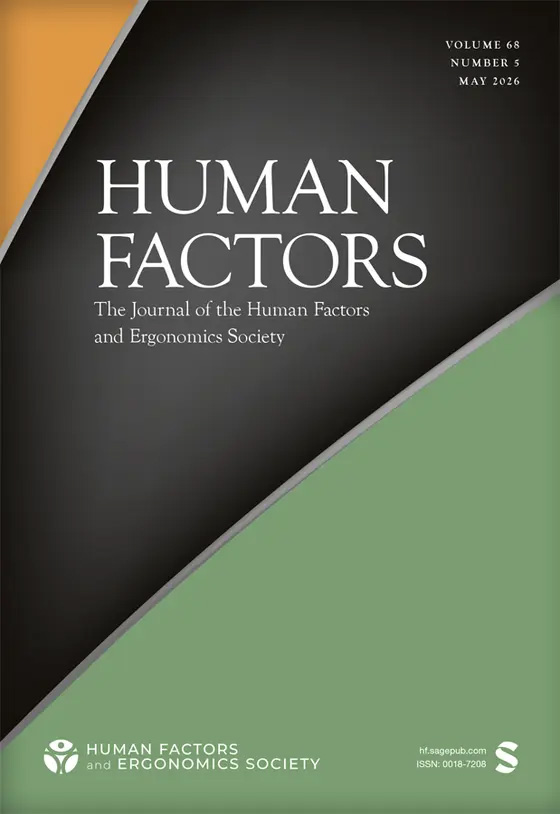
Human Factors

Impact Factor: 3.3

Editor-In-Chief: Robert G. Radwin

Society Affiliation: Human Factors and Ergonomics Society

Sub-Specialty: Psychology, Counseling

Discipline: Psychology, Psychiatry, Counseling

Description:

Human Factors published its first issue in 1958. It is the flagship journal of the Human Factors and Ergonomics Society. Submissions on a wide variety of topics are welcome.Human Factors will be of particular interest to those interested in areas such as human factors/ergonomics, human systems integration, automation, robotics, human-computer interaction, transportation, health-care systems, aviation, aerospace, aging, teamwork, education and training, military systems, architecture, applied psychology, biomechanics, cognitive psychology, cognitive science, industrial engineering, neuroergonomics, and user-centered design.Manuscript TypesResearch Article. Research articles represent the most common type of contribution to Human Factors. These articles report previously unpublished original research that is experimental (field or laboratory based), methodological, or theoretical in nature. These articles report a single experiment or concept that is fully developed and includes a statistical analysis (when appropriate). This mechanism is not appropriate for the reporting of preliminary or pilot data.Extended Multi-Phase Study. Multi-phase studies report on a sequence or series of closely related original studies that are best discussed collectively instead of through multiple original articles. Research approaches encompassed in such a series of studies could include more than one experiment or a mixture of experiments, observational studies, modeling, surveys, ethnographic studies, and so on. The series must have a theoretical underpinning that makes its inclusion in the same report a logical progression. This mechanism is not appropriate for single-experiment or single-model reporting, nor is it an appropriate mechanism for reporting pilot study results along with a single experiment. Each component (experiment) of the sequence of studies must be able to be statistically evaluated independently.Review Article. Review articles present a synthesis of previously published work on a specific topic of interest to the human factors/ergonomics community. These articles are intended to scientifically analyze a body of literature and synthesize the information in an original manner. Review articles must provide an original perspective on the literature, not merely a summary but an extension of knowledge on a topic. Integrative literature reviews based on various methods (narrative, systematic, meta-analytic) are encouraged.Replication Study. Authors who wish to reproduce prior research studies are invited to submit a proposal to submit a replication study. The journal intends publishing the resultant articles provided that the research follows all agreed protocols and meets the usual high standards of clarity and exposition expected by the journal. All articles will be subjected to peer review in the usual way, notwithstanding the purpose of the article, which is to attempt replication of a previously published study.Special Issue/Section Articles. Proposals for consideration of a special section or issue should be submitted to the Editor-in-Chief Robert Radwin. Submit your manuscript today at https://mc.manuscriptcentral.com/humanfactors.

Link To Journal

Sage Media Kit

Contact Our Sales Team