


Dementia
Impact Factor: 2.2
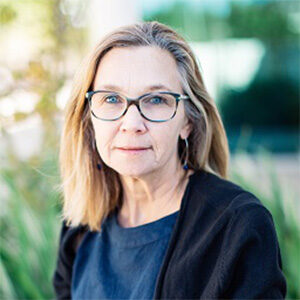
Editor-In-Chief: Caroline Swarbrick and Pamela Roach
Society Affiliation: Not a society journal
Sub-categories (Sub-Specialty):
Discipline: Aging, Gerontology
Description:
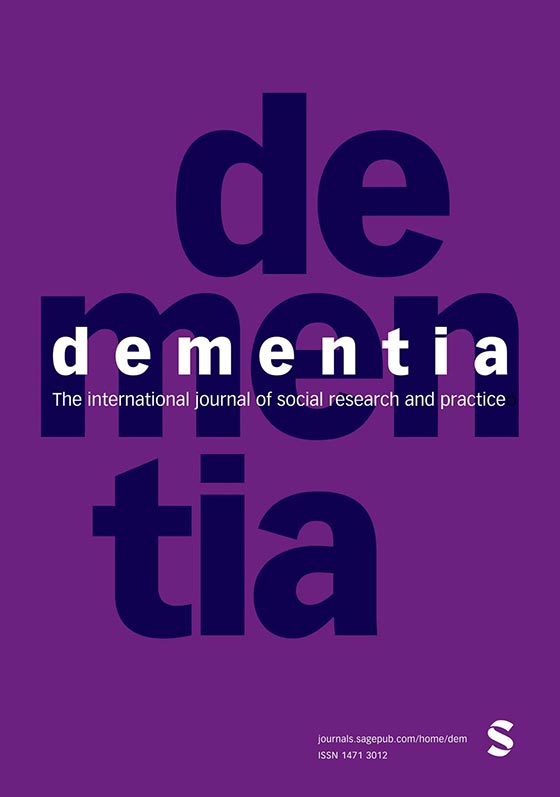
Now accepted for inclusion in the Social Sciences Citation IndexDementia: The International Journal of Social Research and Practice provides high-quality evidence, commentaries, and book reviews, for the field of dementia generally, and social research specifically. Dementia acts as a major global forum for social research of direct relevance to understanding lived experience and improving the quality of life, well-being, and quality of care for people with dementia, their families, and communities.The aim of the journal is to publish high-quality original research, or original scholarship contributions, to the existing literature on social research and the lived experience of dementia. The journal will consider all relevant designs, methods and methodologies that meet this aim, including high-quality evaluations and service improvement studies in relation to quality of life, well-being, and quality of care. The journal will consider narrative-based and/or other forms of literature review that seek to address social research questions in dementia studies; such reviews need to have a systematic approach to the review process and offer a novel insight. Contributions from people with lived experience of dementia will be considered. All original research published in the journal must comply with ethical approval processes.Dementia is hosted on SAGE track; a web based online submission and peer review system powered by ScholarOneTM Manuscripts. Please visit http://mc.manuscriptcentral.com/dementia to log in and submit your article online.All original papers must be submitted to the journal via the online system. The online submission process follows a standard format and contributors will be asked to confirm that all authors have agreed to the submission and that the article is not currently being considered for publication by any other paper-based or electronic journal. All submissions should avoid the use of insensitive and demeaning language, such as ‘the elderly’ (use ‘older people’) or ‘dementia patients’ (say people with dementia, or patients with dementia if the context is clinical). We recommend that authors refer to either the Dementia Engagement and Empowerment Project (DEEP) guidance on language about dementia Making things more accessible – DEEP (dementiavoices.org.uk) Or, Alzheimer’s Australia sets out guidelines for dementia-inclusive language[https://fightdementia.org.au/sites/default/files/NATIONAL/documents/language-guidelines-full.pdf]. Please avoid using abbreviations in your manuscript. Certain abbreviations such as QoL (for quality of life), MMSE (for Mini-mental State Examination), and the UK (United Kingdom) are acceptable, but do not use abbreviations for groups of people such as PWD (for people with dementia) or which detract from the overall flow of the manuscript, such as PCC (Person-Centred Care) and LTC (long-term care). Finally, the Journal promotes the use of gender-neutral language, e.g., staff (not manpower) and lay terms (not layman). Submissions which do not comply with these guidelines will be returned by the handling Editor. Special editions of Dementia are commissioned by the journal’s Editors and we welcome suggestions for such copy. If you would like to consider being a Guest Editor(s) of Dementia and have a topic in mind, please contact Dr Lillian Hung (lillian.hung@ubc.ca) and/or Dr Pamela Roach (pamela.roach@ucalgary.ca) in the first instance.For all other original articles, including literature reviews, Dementia operates a strictly anonymous peer review process in which the reviewer’s name is withheld from the author and the author’s name from the reviewer(s). We aim for each manuscript to be reviewed by two reviewers but the Editors reserve the right to return the decision to the author with more, or less, reviews depending upon the context and circumstances of the submitted article. All manuscripts are reviewed as rapidly as possible and correspondence with the main author will be undertaken electronically. All submitting authors should be mindful that their manuscript may be reviewed by a person living with dementia as part of the journal’s Editorial Board.
Link To Journal
Sage Media Kit
Contact Our Sales Team


